






Persistent questions in a complex disease
Necrotizing enterocolitis (NEC) is one of the most severe gastrointestinal diseases encountered in neonatal care. It predominantly affects preterm infants and is associated with substantial mortality and long-term morbidity. Infants requiring surgery are at particularly high risk of septic complications, extensive bowel loss, intestinal failure and adverse neurodevelopmental outcomes.
For more than three decades, members of our interdisciplinary team have cared for infants with NEC and their families. The same fundamental questions have repeatedly arisen: Why does one infant develop fulminant disease while another follows a milder course? Which children are at greatest risk of deterioration? Why does one infant survive while another does not? And what are the long-term consequences for survivors?
The experience of a single centre rarely provides enough patients to answer these questions adequately. These clinical uncertainties therefore became the starting point for a research programme that evolved from retrospective studies to multicentre collaborations, cooperation with national neonatal networks and, ultimately, the International Registry for Necrotizing Enterocolitis (IRNEC), a disease-specific international registry. IRNEC did not emerge simply from the intention to build a database. It developed from the need to address clinical questions that individual centres could not answer alone.
From clinical observations to structured research
One of the earliest questions was whether routinely available clinical and laboratory parameters could identify infants at particularly high risk before surgery. In 2006, a simple preoperative mortality score based on clinical and laboratory findings, including elevated lactate levels, was proposed [1]. This work suggested that clinically meaningful risk stratification was possible, while also demonstrating the limitations of small retrospective cohorts.
Subsequent studies investigated inflammatory and immunological factors, congenital heart disease, patent ductus arteriosus and predictors of mortality [2,3,5,6]. These projects depended on close collaboration between paediatric surgeons, neonatologists, intensivists, laboratory researchers and statisticians.
As the questions became more specific, the methodological challenges became increasingly apparent. Definitions and clinical practices differed between institutions, relevant variables were not collected consistently and patient numbers at individual centres remained limited. A sustainable multicentre infrastructure was therefore needed in which cases could be identified systematically, variables defined consistently and new questions investigated collaboratively.
Building a disease-specific registry
Against this background, the NEC registry was established in Bern in 2017 by an interdisciplinary clinical and research team. Its purpose was not only to document cases, but to provide a durable infrastructure for interdisciplinary and multicentre research. The subsequent evolution from a single-centre registry to an international collaborative research platform is summarised in Figure 1.
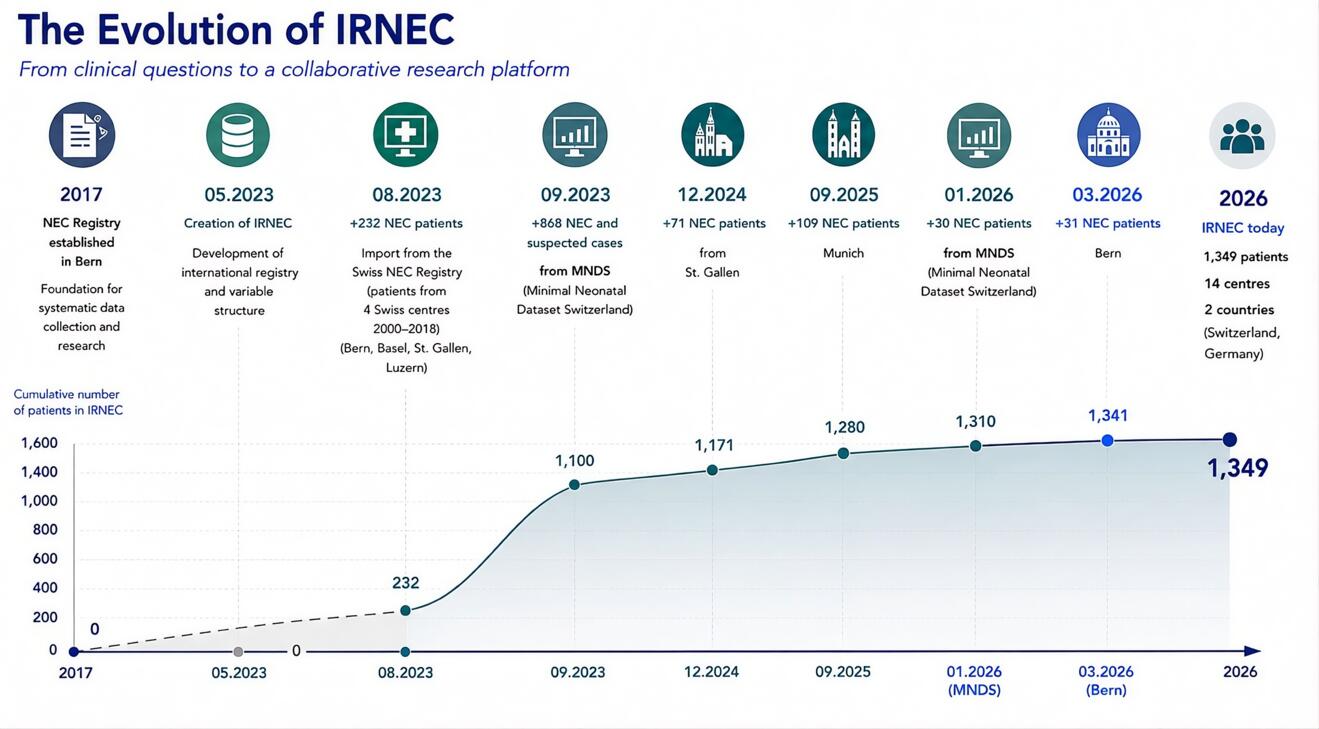
Figure 1. The evolution of IRNEC
Evolution of IRNEC from the Bern NEC Registry to an international collaborative research platform. The timeline illustrates major stages of data integration and the cumulative growth of the registry. MNDS, Minimal Neonatal Dataset Switzerland.
The registry includes infants with suspected or confirmed NEC as well as infants with spontaneous or focal intestinal perforation (SIP/FIP). These conditions can be difficult to distinguish during the early clinical course, although their pathophysiology, treatment and outcomes may differ.
Unlike many neonatal databases focusing on infants born before 32 weeks of gestation or weighing less than 1,500 g, IRNEC includes affected infants across all gestational ages and birth-weight categories. The registry currently includes 145 infants born above 32 weeks of gestation and 154 infants with a birth weight above 1,500 g. This allows NEC to be studied not only in extremely preterm infants, but also in late-preterm and term-born infants.
The REDCap database is hosted by the Clinical Trials Unit at the University of Bern. A minimal dataset of approximately 104 variables captures essential demographic, diagnostic, therapeutic and outcome information. An extended dataset of approximately 340 variables permits more detailed investigation of surgical treatment, laboratory parameters, comorbidities, nutritional outcomes and longer-term morbidity. The variable framework and the distribution of minimum and extended registry variables across the different clinical domains are illustrated in Figure 2.
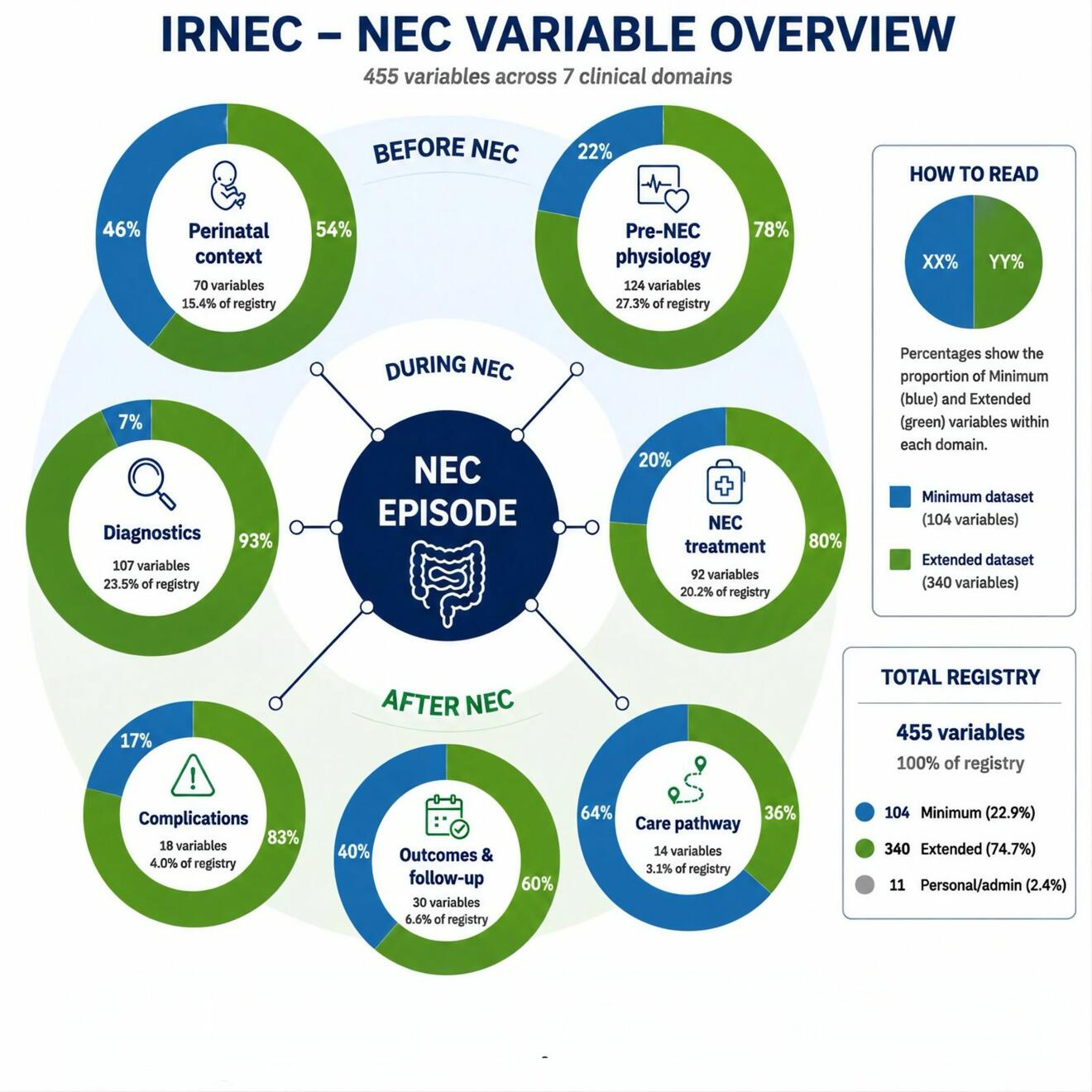
Figure 2. IRNEC variable framework
Overview of the IRNEC variable structure across clinical domains before, during and after an NEC episode. Blue indicates variables included in the minimum dataset and green variables included in the extended dataset.
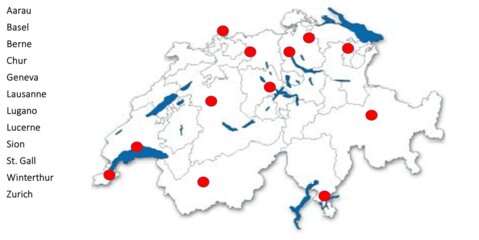
The registry currently contains data on 1,349 infants treated between 2000 and 2026. These records originate from 14 centres in Switzerland and Germany: Aarau, Baden, Basel, Bern, Bruderholz, Chur, Geneva, Lausanne, Lucerne, Munich, St. Gallen, Winterthur, Zollikerberg and Zurich. Data entered IRNEC through different collaboration pathways, including direct centre-based contributions and retrospective data transfers. Extended information is available for at least 334 patients.
This two-tier structure balances broad coverage with scientific depth: the minimum dataset provides a standardised core structure across different forms of data contribution, while the extended dataset supports detailed analyses of selected patient cohorts and specific research questions.
Data transfers and collaborative analyses are subject to the applicable ethical approvals, institutional requirements and data-transfer agreements.
Looking beyond survival
Early NEC research understandably concentrated on mortality. However, survival alone is not a sufficient outcome measure for affected children and families.
In a systematic review and meta-analysis, Hau et al. analysed 58 studies comprising 4,260 survivors of surgery for NEC [4]. Intestinal strictures occurred in approximately 24% of patients, intestinal failure in 13%, recurrent NEC in 8% and adhesive bowel obstruction in 6%.
The considerable heterogeneity between studies underlined the need for standardised outcome definitions and structured long-term follow-up. Collaborative NEC research must therefore extend beyond preventing death to preserving intestinal function, reducing subsequent surgical procedures and improving long-term development and quality of life.
Complementary strengths: IRNEC and SwissNeoNet
IRNEC and the Swiss Neonatal Network provide complementary research structures. Within its established governance framework, SwissNeoNet provides prospectively collected, population-based information from Swiss neonatal intensive care units, enabling robust epidemiological analyses in very preterm infants. IRNEC complements this information with detailed disease-specific and surgical variables, includes affected infants across gestational ages and allows selected questions to be examined in greater depth.
Within the broader NEC research programme, SwissNeoNet therefore represents an important scientific partner.
A recent study conducted with the Swiss Neonatal Network analysed 15,635 infants born before 32 weeks of gestation over a 22-year period [7]. The overall incidence of NEC was 2.84% and remained stable between 2000 and 2021. Multiple gestation itself was not associated with an increased risk, and NEC-related mortality remained high at approximately 36%.
However, when one twin developed NEC, the odds of NEC in the co-twin increased approximately sixfold, corresponding to an estimated risk increase from 2.7% to 15%. This clustering suggests shared environmental, perinatal or biological factors and indicates that the co-twin of an affected infant may warrant particularly vigilant surveillance.
The finding also generates new scientific questions concerning shared exposures and underlying mechanisms. It illustrates how population-based observations can produce hypotheses that may subsequently be investigated using disease-specific datasets and international cohorts.
From national registry to international platform
Following its development in Switzerland, IRNEC was progressively opened to international partners. International expansion is necessarily a stepwise process requiring ethical approvals, data-transfer agreements, consistent definitions and reliable quality control.
Further harmonisation with international initiatives and agreed core indicators could improve the comparability of NEC datasets and facilitate prospective studies and international comparisons of treatment and outcome.
IRNEC should therefore be understood not merely as a central database, but as a collaborative research platform based on mutual trust, transparent governance and shared scientific responsibility.
AI-assisted data extraction
The scientific value of a registry depends on the reliability and completeness of its data. Manual extraction of detailed clinical information from medical records is time-consuming and represents a major barrier to the expansion of disease-specific registries.
IRNEC is therefore evaluating artificial intelligence-assisted data extraction. In an initial pilot project, records from 16 infants treated at tertiary centres in Bern and Munich were analysed. Predefined registry variables were extracted using an AI-assisted approach and compared with manually curated reference data.
Manual extraction required an average of approximately 27 minutes per patient, compared with approximately 2.5 minutes using the AI-assisted approach. The AI-assisted extraction achieved approximately 94% agreement with the reference dataset and also helped to identify missing or inconsistent information in some manually entered records.
These preliminary findings require validation in larger cohorts, institutions, documentation systems and languages. Artificial intelligence should not replace clinical expertise or human quality control. Its potential lies in reducing repetitive work, identifying missing information and allowing researchers to concentrate on validation, interpretation and clinically relevant questions.
A living research infrastructure
The evolution of IRNEC demonstrates how persistent clinical questions can develop into a structured research programme. Attempts to understand and predict the course of NEC led to interdisciplinary studies, cooperation with the Swiss Neonatal Network and the development of an international disease-specific platform.
This development has never been the work of a single person or discipline. It has depended on paediatric surgeons, neonatologists, intensivists, epidemiologists, study coordinators, statisticians and data specialists working across institutional and national boundaries. Most importantly, it has depended on the trust and contribution of affected infants and their families.
The future value of IRNEC will not be determined solely by the number of patients contained in a database. It will depend on the relevance of the questions, the quality of the data and the strength of the collaboration between participating centres, data-contributing partners and scientific networks.
The registry is therefore not the final objective. It is a tool that allows rare but clinically important events to be studied systematically. The objective remains unchanged: to understand NEC more clearly, identify infants at risk earlier and improve both survival and long-term quality of life.
- Kessler U, Mungnirandr A, Nelle M, Nimmo AF, Zachariou Z, Berger S. A simple presurgical necrotizing enterocolitis mortality scoring system. J Perinatol. 2006;26:764–768.
- Kessler U, Schulte F, Cholewa D, et al. Outcome in neonates with necrotizing enterocolitis and patent ductus arteriosus. World J Pediatr. 2016;12:55–59.
- Kessler U, Hau EM, Kordasz M, et al. Congenital heart disease increases mortality in neonates with necrotizing enterocolitis. Front Pediatr. 2018;6:312.
- Hau EM, Meyer SC, Berger S, Goutaki M, Kordasz M, Kessler U. Gastrointestinal sequelae after surgery for necrotising enterocolitis: a systematic review and meta-analysis. Arch Dis Child Fetal Neonatal Ed. 2019;104:F265–F273.
- Haefeli S, Kordasz M, Tsai C, et al. Risk factors for necrotizing enterocolitis in infants with patent arterial duct: a retrospective matched paired analysis. Front Pediatr. 2020;8:179.
- Kordasz M, Racine M, Szavay P, et al. Risk factors for mortality in preterm infants with necrotizing enterocolitis: a retrospective multicentre analysis. Eur J Pediatr. 2022;181:933–939.
- Milosevic M, Stalder T, Haefeli S, et al.; Swiss Neonatal Network. Epidemiology of necrotizing enterocolitis in multi-birth preterm infants: a 22-year retrospective study in Switzerland (2000–2021). J Pediatr Surg. 2026;61:163237.