Editorial by Michael Demean, Board Member of Swiss Young Surgeons
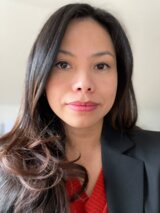
A career in surgery does not always follow a straight line. In this personal contribution, Dr Birsner describes her journey from clinical surgery to insurance medicine, healthcare management and Clinical Digital Health. She shows how new perspectives can complement a strong surgical identity and deepen our understanding of the systems surrounding patient care. This perspective is particularly relevant as artificial intelligence and digital tools increasingly become an extended arm in our daily work. At the same time, personal exchange, mentoring, communication and networking remain essential for professional development. The article reminds surgical residents that there is no single correct career path. It encourages us to remain clinically grounded, open to new perspectives and willing to continue learning.
This article reflects on a personal journey from clinical surgery towards a broader understanding of healthcare systems, insurance medicine, international experience and Clinical Digital Health. It aims to encourage young surgeons to remain rooted in the craft of surgery while staying curious, open to lifelong learning and willing to explore different professional paths. Rather than presenting one ideal career model, it highlights the importance of finding one’s own direction with authenticity, courage and conviction.
Surgery as a Lifelong Commitment
Surgery is not a profession that ends with graduation, medical licensing or specialist certification. It is a lifelong commitment to learning, responsibility and personal development. For young surgeons, this is one of the most important insights to recognise early. Surgical training creates the foundation, but it cannot provide every answer for an entire professional career. Techniques evolve, guidelines change, digital tools enter clinical workflows, and healthcare systems are becoming increasingly complex.
At its core, surgery remains a craft. It requires discipline, precision, resilience, humility and respect for patients. It is learned through repetition, mentoring, feedback, difficult cases and self-reflection. The operating theatre teaches not only anatomy and technique, but also judgement, teamwork, communication and responsibility. These fundamentals must never be underestimated.
My own professional path began with traditional clinical training. I studied medicine and completed my doctoral thesis at the University of Tuebingen in Germany and later completed my surgical training in Switzerland. My clinical career has taken me through several important institutions, including University of Zurich, University of Tuebingen, Cantonal Hospital Schaffhausen, Cantonal Hospital Winterthur and Spital Buelach. Each hospital shaped me in a different way. Each environment taught me something about surgical practice, teamwork, patient care, leadership and the reality of healthcare systems.
Over time, I realised that being a surgeon means more than becoming technically competent. It also means understanding the environment in which surgical care takes place. Surgery does not happen in isolation. It is connected to hospital structures, insurance systems, legal frameworks, digital infrastructure, leadership decisions and patient pathways. This insight gradually broadened my professional perspective without leading me away from surgery.
Why I Wanted to Understand the System
My change of direction did not arise from a wish to leave surgery. It arose from clinical practice and from the need to understand the system surrounding surgical care more deeply. In everyday hospital work, I saw that good patient care depends not only on clinical knowledge and operative skill, but also on functioning processes, clear communication, efficient structures and fair decision-making.
I wanted to understand hospital management, the insurance system and the Swiss healthcare system. Without gaining other perspectives, it is difficult to contribute meaningfully to change within a system. A well-known thought from Mahatma Gandhi captures this clearly: “anyone who wants to contribute to change within a system must also be prepared to change their own perspective”. For me, this meant opening my perspective and continuing to learn beyond the traditional surgical pathway.
My first step in this direction was work in insurance medicine at SUVA and training as a medical expert with Swiss Insurance Medicine (SIM). Through this, I gained two additional perspectives: the insurance perspective and the legal perspective. I learned how medical decisions are assessed outside the clinical setting, particularly with regard to causality, work capacity, documentation, rehabilitation and medico-legal responsibility.
In parallel, I began an MBA with a focus on Healthcare Management and Digital Health. This program connected naturally with my training in insurance medicine. Both areas address ethical, legal and organisational frameworks within healthcare systems. For me, this created a deeper understanding of how clinical work, regulation, responsibility, management, process design and digital system design are connected. In addition, I am currently focusing on further training in AI in Healthcare at NUS Yong Loo Lin School of Medicine in Singapore.
The driving force behind this development was also personal. I enjoy learning, developing myself and taking on meaningful challenges. Already during medical school, I started an experimental doctoral thesis that included three years of laboratory work at the Institute of Microbiology at the University of Tuebingen, Germany. This experience shaped me early: it taught me patience, discipline and scientific curiosity, but it also revealed something about my personality. I realised that I enjoy taking on new challenges, developing ideas and contributing to change rather than simply accepting things as they are.
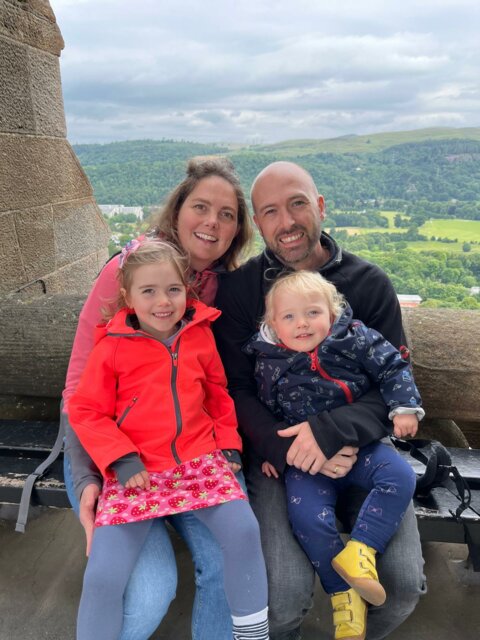
Later, an opportunity arose to move to Singapore for professional and family reasons. I took this step with my entire family. I am married and have two children, aged 11 years and 1.5 years. Moving internationally with a family was not only a professional decision, but also a personal challenge that required courage, flexibility and trust. In Singapore, I was able to join a fellowship at the National University Hospital Singapore and to take part as a moderator in a scientific session at the WCES World Congress of Endoscopic Surgery 2025 in Singapore. This opportunity arose through networking within the Swiss hernia association. The experience confirmed something important for me: congresses are valuable not only for professional learning, but also for networking. They offer young surgeons the opportunity to gain new scientific and clinical insights, exchange ideas with colleagues and build professional connections. Young surgeons should therefore be encouraged to attend congresses whenever possible, including international meetings. Sometimes, a conversation at a congress can open a door that would otherwise have remained invisible.
These steps were not always easy. Moving between clinical surgery, insurance medicine, management studies, Digital Health, international networking and family responsibilities required commitment. Nevertheless, I am grateful for these challenges, because they allowed me to grow. Professional development often begins outside the comfort zone.
Clinical Excellence and Broader Possibilities
Every future-oriented surgical career must begin with clinical excellence. Digital Health does not replace anatomy. Artificial intelligence does not replace responsibility. Management knowledge does not replace surgical judgement. Anyone who wishes to contribute to change within the healthcare system should first respect and understand the foundations of clinical practice.
At the same time, surgical competence is more than operative skill alone. It includes decision-making, communication, ethical responsibility, teamwork, leadership and the ability to improve processes. Experienced surgeons play a central role in this development. Their judgement, calmness in difficult situations and practical wisdom cannot be replaced by technology. Young surgeons should learn from this experience with respect and humility.
The future of surgery should therefore not be described as young versus old, digital versus traditional, or innovation versus experience. Surgery needs all of these elements together. Tradition gives us stability and identity. Innovation gives us tools for improvement. Experience protects us from naivety. Curiosity prevents us from standing still.
For young surgeons, it is important to know that there is not only one correct career path. Some will choose a hospital-based surgical career and dedicate themselves fully to clinical work. Others may go into research, teaching, quality improvement, leadership, insurance medicine, management or Digital Health. These paths are not a departure from surgery or from the medical profession, rather, they are different ways of contributing to the same field.
Every surgeon can decide individually which direction fits their own values, personality, family situation and professional goals. A career does not have to be completely planned from the beginning. Orientation often develops gradually through experience, curiosity and openness. What matters is not copying another person’s path but finding one’s own path honestly and with conviction.
Clinical Digital Health as a Natural Extension
Clinical Digital Health became my focus because it connects many parts of my path: clinical surgery, systems thinking, insurance medicine, healthcare management, ethics, legal frameworks and international experience.
For me, Digital Health does not mean using technology simply because it is modern. I am interested in how digital solutions can truly help in everyday clinical practice and within the Swiss healthcare system: by making processes easier, improving access to information, reducing unnecessary burden and ultimately improving the care of our patients. It is a way of asking how healthcare and hospital care can become safer, more efficient, more patient-centred and more sustainable.
Clinical Digital Health includes digital documentation, risk stratification, targeted interventions, decision-support systems, telemedicine, artificial intelligence, remote monitoring, patient pathways, data platforms, simulation surgical training and digital continuing education. These tools should not primarily be seen as a threat to existing roles. Used appropriately, they can support healthcare professionals, reduce repetitive administrative work and allow medical staff to focus more strongly on the tasks for which their expertise is truly needed.
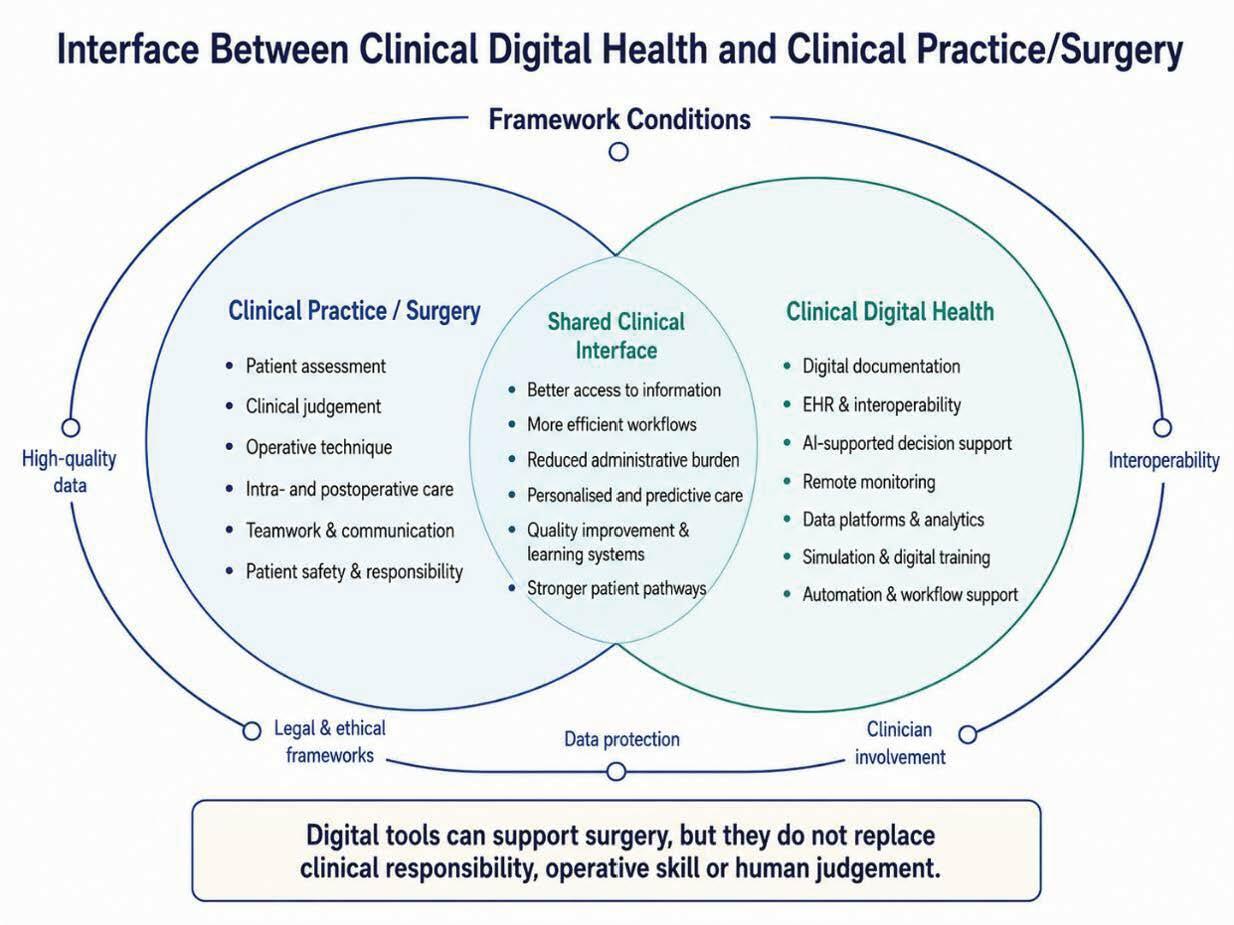
In the future, AI may also contribute to the improvement of surgical techniques and surgical instruments. Robotic surgery, laparoscopic procedures, hospital operating workflows and perioperative documentation already generate large amounts of valuable clinical and procedural data. These data are highly valuable because they may help train future AI systems to analyse operative patterns, identify risk factors, support technical refinement and contribute to the development of smarter surgical instruments. If used responsibly, this could support more personalised treatment, improve patient safety and reduce complications. However, this potential depends on high-quality data, interoperability, legal and ethical safeguards, and the active involvement of surgeons who understand the clinical reality behind the data.
The goal is not to replace doctors. The goal is to strengthen surgical and patient care. Digital tools should help reduce unnecessary workload, improve access to information, support decision-making, promote education and create better patient pathways. However, this only works if digital systems are developed with an understanding of clinical reality. Poorly designed digital solutions in healthcare can increase frustration, disrupt workflows, provide no real benefit for patients and, at the same time, endanger data protection.
This is why surgeons should participate in digital transformation. They understand where processes fail, where communication breaks down, where documentation becomes burdensome and where patients need better support. Young surgeons do not need to become software developers, but they should understand the language of data protection, legal frameworks, interoperability, patient safety, usability and implementation.
For me, focusing on Clinical Digital Health means remaining committed to medicine and surgery while expanding my perspective. It allows me to connect clinical experience with IT-systems thinking and to contribute to the future of surgical and medical care in a way that fits my personality and values.
Conclusion: Finding One’s Own Path and Following It with Conviction
The future of surgery needs strong clinical foundations and lifelong learning. Young surgeons should respect the craft, learn from experienced colleagues and build solid technical and clinical competence. At the same time, they should remain open to different possibilities after medical school: research, a hospital-based surgical career, leadership, management, insurance medicine, quality improvement, international exchange/fellowship or Digital Health.
My own path from surgery towards insurance medicine, international exchange and Clinical Digital Health is only one example. It is my personal path, shaped by my experiences, my family situation, my personality and my convictions. It is not a universal template. Every surgical career can look different, and this is precisely one of the strengths of the field.
The central message of this article is simple: stay true to yourself. Find out what kind of surgeon you want to become, what motivates you and where your strengths can create value. Once you have found your path, follow it with full conviction. In doing so, we support not only our own professional development, but also the healthcare system and, above all, our patients. A surgeon who works with clarity, purpose and authenticity can contribute more meaningfully to surgical and medical care. Remaining loyal to surgery does not mean remaining unchanged. Sometimes it means broadening one’s perspective, accepting challenges and allowing oneself to grow.
With this contribution, I hope to encourage young surgeons to stay curious, trust their own path, and contribute actively and authentically to the future of surgery.