

This nationwide retrospective cohort study examined how the timing of perioperative antibiotic administration influences postoperative outcomes in elective and emergency colorectal surgery. Using data from the Swissnoso surveillance programme database, the researchers analysed 63,945 colorectal operations performed between 2009 and 2020. In the cohort, 16,939 were emergency procedures (26.5%). In this subset, patients were older, had higher ASA scores, more contaminated wounds, and received broader-spectrum antibiotics more often than elective patients. The primary outcome was 30-day mortality; SSI served as the secondary outcome. Timing of the antibiotic dose given closest to the incision was assessed using natural cubic spline modelling to capture non-linear effects.
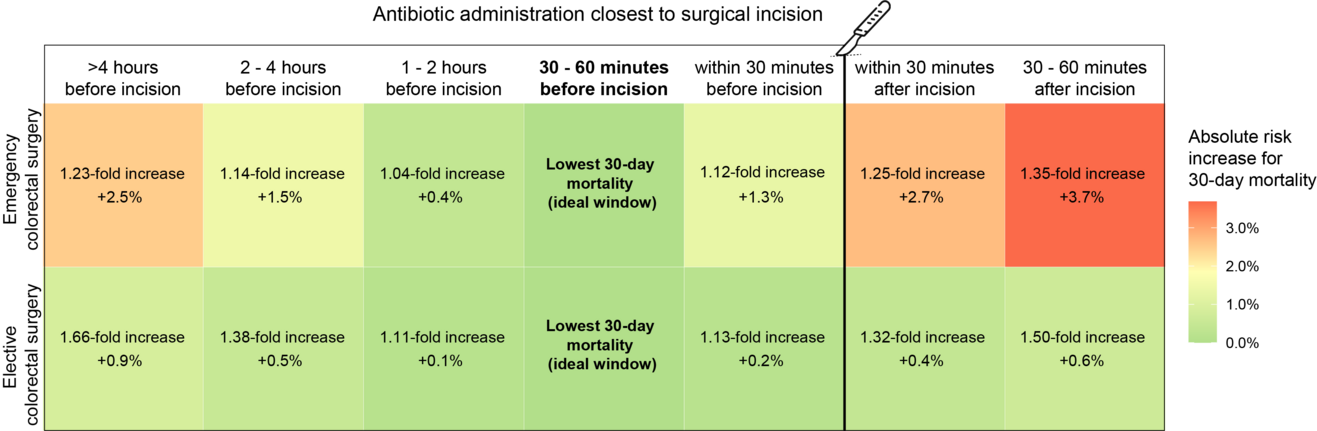
Overall, 73.6% of elective and 57.0% of emergency patients received antibiotics within 60 minutes before incision, while emergency cases showed a wider and less controlled timing distribution. Thirty-day mortality was significantly higher in emergency versus elective surgery (12.0% vs. 1.4%). After adjustment for patient and surgical factors, emergency surgery remained strongly associated with mortality (aOR 2.93). Crucially, antibiotic timing showed a significant U-shaped association with mortality in both procedure types: risk increased when antibiotics were administered either too early or too late relative to incision. The lowest predicted mortality occurred when antibiotics were given approximately 50 minutes before incision—47 minutes for elective cases (1.28% predicted mortality) and 51 minutes for emergency cases (10.50%). These associations were consistent in sensitivity analyses. Antibiotic timing, however, was not associated with SSI risk, which was driven primarily by wound contamination, ASA score, male sex, and open surgery.
We suggest that in emergency settings—where patients typically receive therapeutic antibiotics early after admission and before surgery, pre-incision redosing may help maintain effective intraoperative antimicrobial levels. Aligning emergency workflows with prophylaxis principles used in elective surgery may improve the achievement of optimal timing. The study supports updating guidelines to include explicit timing recommendations for emergency colorectal surgery.
Interview with Dr. med. Sarah Peisl and Prof. Dr. med. Beat Schnüriger (Bern)
What inspired you to conduct this study?
In emergency surgery, we very frequently encounter this one question by the anesthesiologist while prepping for surgery: “The patient has received antibiotic 3 hours ago — do you want to repeat it now?” Patients may receive antibiotics in the ER or on the ward long before they reach the operating room, leading to highly variable timing. The timing of preincisional antibiotic can be difficult to coordinate, especially overnight or in emergency situations. We realized that, even though this issue comes up every day for surgeons and anesthetists, there is very little guidance in the literature or in current guidelines. This uncertainty in daily practice motivated us to study whether preoperative antibiotic timing affects outcomes, especially in the emergency setting, and to explore whether the same principles used in elective surgery, with clear administration recommendations, could help improve patient care.
Were there any unexpected findings?
We were initially surprised to observe a clear association between antibiotic timing and 30-day mortality, but no association with surgical site infections (SSI). This seems counter-intuitive because perioperative antibiotics are primarily intended to prevent SSI. However, postoperative infections extend beyond the surgical site. The strong link with mortality may reflect a reduced risk of other infectious complications, such as pneumonia, urinary tract infections, or catheter-related infections, that were not captured in our database. So while SSI rates were unaffected, optimal antibiotic timing may still provide important protection against broader postoperative infectious risks.
What is the direct impact on the surgeon’s work?
Our findings underline that antibiotic timing is important, also in emergency colorectal surgery. Surgeons should be more aware that antibiotics given hours before incision for therapeutic reasons may no longer provide effective antimicrobial coverage during the operation, which is a physiological stressor that can increase bacterial translocation and infection risk. This means we should consider pre-incision redosing more proactively and work closely with anesthesia teams to coordinate timing, especially in emergency situations. At the same time, we must take individual factors into account, such as renal function and the antimicrobial’s half-life, to avoid unnecessary dosing. By applying the same timing principles used in elective surgery, we may improve outcomes for our patients.
What is your learning point from this project?
We went into this project assuming that antibiotic timing would matter, but analyzing a large national cohort really demonstrated just how inconsistent and challenging antibiotic timing is in emergency surgery. We also learned that the impact goes beyond SSI, suggesting that timely antibiotics may help prevent other serious postoperative infections that contribute to mortality. This has already made us more vigilant in our own practice to ensure appropriate antimicrobial coverage at the time of incision. Overall, the project strengthened our view that clearer guidance and improved coordination in emergency workflows are needed to deliver the best care possible.
Are there any subsequent projects planned?
Yes. While nothing is finalized yet, we are currently preparing the groundwork for a prospective study in emergency surgery to validate these findings. Our goal is to better control antibiotic workflows, assess broader infectious outcomes, and ultimately provide stronger evidence to inform future guideline recommendations.